


A single NHL contract can weigh down a roster for over half a decade. Most teams price players based on what they have already done: their points, hits, and time on ice. This approach ignores one of the biggest risks in a hard-cap league: future availability.
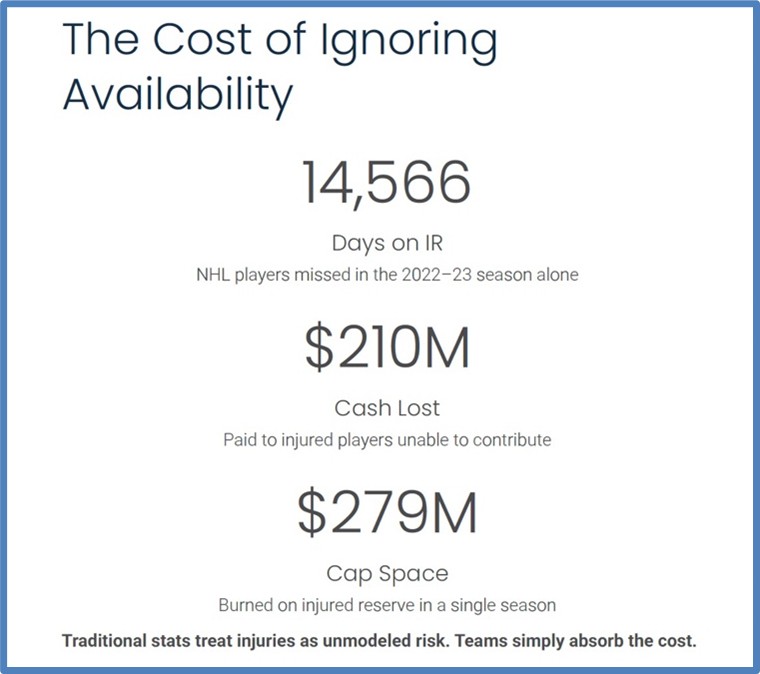
In the 2022-23 season alone, NHL players spent 14,566 days on injured reserve. That cost teams roughly $210 million in cash and $279 million in cap space. Traditional stats treat these injuries as unmodeled risks that a team simply must absorb.
We can do better. By analyzing over 15 years of NHL data and 585 different player features, we can now predict a player’s career games played with high accuracy. This shifts the conversation. Instead of only asking what a player has done, general managers can now ask how much longer that player will be able to do it.
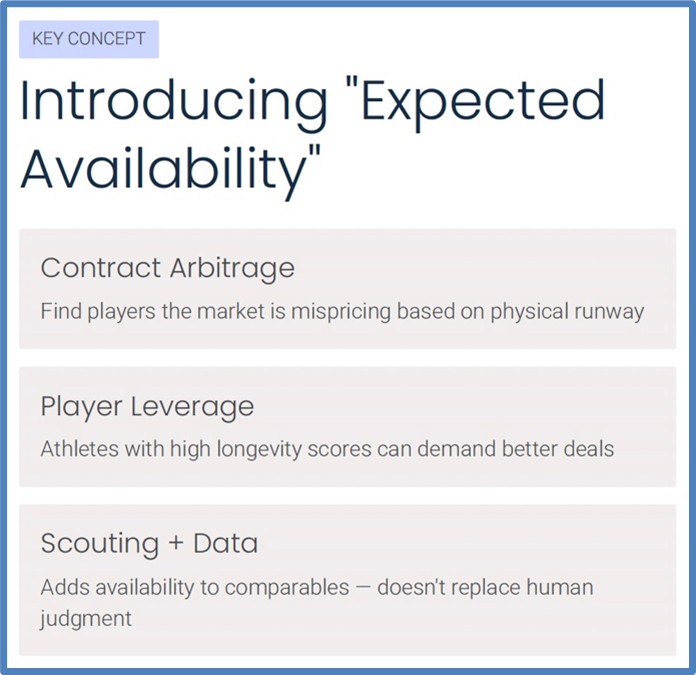
The goal isn’t to replace scouting. It is to add “expected availability” to the list of comparables used during negotiations. This allows teams to find contract arbitrage – opportunities where the market is mispricing a player’s physical runway – and empowers players to leverage longevity into contract value.
Paying for Production vs. Paying for Presence
To understand how availability-adjusted valuation works, look at the comparison between point-producing forwards Brock Boeser and Ivan Barbashev.
On the surface, their cost per point is nearly identical. Boeser costs about $93K per point, while Barbashev is around $88K. But the picture changes when you look at their “ARC” profiles (Availability, Reliability, and Capability).
- Brock Boeser: His actual time on the ice closely follows what the models expect. His $40 million commitment buys both scoring and a stable availability profile.
- Ivan Barbashev: His expected absences have trended upward, from two or three games early in his career to nearly ten per season now. As his cap hit rises, the amount of time he is actually available to play is trending down.
One contract prices production and stability. The other prices production while the player’s physical availability is becoming more expensive. Identifying these trends before a contract is signed allows a team to distinguish between two players who look similar on a scoresheet but have very different futures. At the same time, the player with the higher availability metric has another data point in favor of a better deal.
Availability as an Insurance Policy
This predictive framework also applies to how teams build their entire free-agent classes. During the 2023 free-agency period, Detroit and Florida took two very different paths.
Detroit invested over $48 million in its incoming class. They paid roughly $47K for every expected game those players will play. Florida spent less – about $29 million – but their cost per expected game was much higher at $84K.
At first glance, Detroit’s move seems more efficient. But Florida’s strategy serves a different purpose. The players Florida let go had very low expected availability. Re-signing that group could have cost the team $104K per game in “lost salary” due to injuries.
Florida paid a premium for its new players, but that premium was essentially an insurance policy for better health and availability. This data doesn’t tell a team which player to sign. It makes the tradeoffs of those signings clear and explicit.
Can We Really Predict a Career?
The effectiveness of this model depends on its accuracy at the individual level. Consider the career of defenseman Jake Muzzin, who retired in 2022 after 755 games.
By 2015 – seven full seasons before Muzzin retired – the model projected he would play 733 games. That is 97% of his actual career total. From that point on, the model’s estimate stayed within a consistent range of his eventual outcome.
Models like this typically stabilize after a player has been in the league for five or six seasons. This is crucial because it happens right before most players sign their second long-term contract.
The Final Call – This is Data, Not a Decision-Maker.
There are still limits. Data cannot account for “the room” – mental toughness, discipline, competitiveness or leadership. Sometimes, signing a veteran whose physical arc is ending is the right move if they can galvanize a young team. Players outperform their predicted performance all the time because they are superior athletes with impeccable health and wellness routines. The most competitive teams will be those that combine this hard evidence with the organizational wisdom that has always driven the final call.